Corporate Governance
Board Committees
The Board of Directors has approved an organizational structure under which specific duties and responsibilities are delegated to its committees. This structure aims to enhance operational efficiency and optimize the use of the Board members’ time. These committees are tasked with reviewing matters presented to them and providing recommendations, while the Board retains full authority and responsibility for all decision-making.
In this context, the Board ensures the clear definition and allocation of roles and responsibilities between the Board and the executive management. This supports the principle of separation between supervisory and executive functions and enhances the effectiveness of the governance framework. The Board is committed to exercising its authorities independently and objectively, relying on accurate and timely information and reports submitted by the relevant Board committees and executive management, thereby enabling informed decisionmaking that safeguards the Company’s longterm interests, protects the rights of shareholders and stakeholders, and ensures the sustainability of operations in compliance with applicable laws and regulations.
The committees are responsible for reviewing and verifying assigned matters and ensuring that tasks are executed efficiently and within the prescribed timelines. The findings and recommendations from these reviews are submitted to the Board, accompanied by detailed implementation plans. The committees also oversee the follow-up of these plans by the relevant departments, ensuring alignment of actions with the Board’s strategic objectives and enhancing the effectiveness of supervisory oversight and institutional governance practices.
At Zain, three committees form the cornerstone of the governance framework: the Risk Committee, the Audit Committee, and the Nomination and Remuneration Committee. Each committee plays a fundamental role in supporting the work of the Board, ensuring robust oversight and effective supervision. Their respective contributions and detailed responsibilities are presented in the following sections of this report.
Board Risk Committee (BRC)
Formed: May 12, 2015
Term:
The term of membership of the Board committees shall run concurrently with the term of the Board of Directors and shall be for a period of three years.
Responsibilities:
The primary purpose of the Board Risk Committee (BRC) is to support the Board of Directors in fulfilling its oversight responsibilities relating to the identification, assessment, and management of risks. These include operational, strategic, and external environmental risks. The Committee plays a central role in reviewing, overseeing, and approving the Company’s risk management policies, frameworks, processes, and practices, ensuring their alignment with the Company’s strategy and objectives.
The Company confirms that the Chairman of the Risk Committee is a non-executive member of the Board of Directors, and that the Chairman of the Board does not serve as a member of the Risk Committee, in alignment with the Corporate Governance Rules issued by the Capital Markets Authority, thereby reinforcing the Committee’s independence and the effectiveness of its oversight role.
The Risk Committee is responsible for ensuring that the Company maintains an optimal balance between risk and return, both in its ongoing operations and in new projects and initiatives.
A key function of the Committee is to assess significant risk exposures and review the measures adopted by management to address them in a timely manner. This includes oversight of emergency interventions as well as ongoing initiatives such as Business Continuity Planning (BCP) and Disaster Recovery Plans (DRP). To enhance effectiveness and transparency, the Committee coordinates with the Audit Committee when required and submits regular reports to the Board of Directors.
The Committee reviews and evaluates the adequacy and effectiveness of the risk management framework, policies, and internal procedures within its scope of responsibility, and recommends necessary enhancements to the Board for approval. It seeks to ensure that executive management’s risk management practices are aligned with the Company’s strategy, objectives, and risk appetite. In this regard, the Committee focuses on both short-term risks addressing immediate events and challenges and long-term risks, mitigating potential future exposures associated with the Company’s growth and expansion.
The Committee also promotes an enterprise-wide risk management culture by enhancing risk awareness across all levels of the Company and encouraging behaviors and practices that enable early identification, assessment, and effective mitigation of risks. This proactive approach helps minimize potential impacts on operational and strategic performance and ensures that risk management is fully integrated into the decision-making process, with a focus on sustainability, protection of stakeholders’ interests, and achievement of the Company’s long-term objectives.
As part of its oversight role, the Risk Committee evaluates the performance of executive management in managing risks, emphasizing adherence to rigorous standards and the adoption of a proactive approach that enables early detection and effective response to risks. These practices contribute to strengthening the Company’s resilience, reducing risk exposure, and supporting the sustainability of its long-term success.
In addition, the Committee oversees the Company’s compliance function to ensure full adherence to regulatory requirements and applicable standards. The compliance function operates independently and conducts its own reviews, providing an additional layer of oversight and assurance. The Committee receives regular reports on compliance matters, risk assessments, and mitigation strategies, thereby enhancing oversight effectiveness, ensuring transparency and accountability, and supporting the Board’s ability to make well-informed strategic decisions.
BRC Achievements in 2025:
- Reviewed and discussed the Risk Management Unit’s quarterly reports for the Group and its subsidiaries, established structured risk mitigation methodologies, and conducted regular quarterly reviews of the Unit’s activities.
- Completed comprehensive assessments of all categories of risks across subsidiaries and oversaw the implementation of measures to mitigate their potential impact.
- Monitored and strengthened cybersecurity protection measures, tracked progress and enhancements in security systems, and ensured continued resilience against evolving cyber threats to maintain the highest levels of protection.
- Reviewed related party transactions, assessed their impact on the Group, and submitted recommendations to the Board of Directors accordingly.
- Launched and sponsored the annual Risk Conference, facilitating collaboration and knowledge sharing among subsidiaries on risk management practices and initiatives.
Committee Members:
- Zaki Hilal AlBusaidi (Chairman)
- Bader Nasser AlKharafi
- Aladdin Baitfadhil
- Yousef Khaled AlAbdulrazzaq
- Atif Said AlSiyabi
Committee Meetings:
| Member | Meeting 1/2025 24/2/2025 | Meeting 2/2025 12/5/2025 | Meeting 3/2025 12/8/2025 | Meeting 4/2025 28/10/2025 |
|---|---|---|---|---|
| Zaki Hilal Al Busaidi (Committee Chairman) |  |
|
|
|
| Bader Nasser AlKharafi | |
|
|
|
| Aladdin Baitfadhil | |
|
|
|
| Yousef Khaled AlAbdulrazzaq | |
|
|
|
| Atif Said AlSiyabi | |
|
|
|
| Percentage of Attendance | 100% | 80% | 100% | 100% |
Board Audit Committee (BAC)
Formed: June 9, 2011
Term:
The term of membership of the Board committees shall run concurrently with the term of the Board of Directors and shall be for a period of three years.
Responsibilities:
The Audit Committee of the Board of Directors plays a pivotal role in supporting the Board in fulfilling its oversight responsibilities across several key areas, including ensuring the quality and integrity of accounting practices, audit processes, internal controls, the risk management framework, and financial reporting, as well as strengthening the Company’s overall corporate governance.
The Committee is responsible for evaluating the performance and qualifications of the licensed independent auditor, managing and assessing the Company’s relationship with the external auditor, overseeing the effectiveness and performance of the Internal Audit function, and ensuring compliance with applicable laws, regulations, and ethical standards.
While the Board of Directors retains ultimate responsibility for risk management, internal controls, and corporate governance, the Audit Committee performs a specialized oversight and advisory role. This includes reviewing the preparation of financial reports, addressing operational and financial risks, ensuring compliance with legal, regulatory, and ethical requirements, and assessing the performance of the Internal Audit function and the independent external auditors.
Through maintaining a robust governance framework, the Audit Committee contributes to enhancing the Company’s integrity and strengthening stakeholders’ confidence in its operations and decision-making processes.
The Committee works to ensure the accuracy and transparency of financial information by monitoring the application of approved accounting standards and reviewing financial disclosures. This enhances the reliability of financial data and enables the Board of Directors and stakeholders to make informed decisions. The Committee also reviews accounting processes and internal control procedures to confirm their effectiveness in identifying and addressing risks at an early stage.
In addition, the Committee oversees all aspects of internal and external audit activities, including reviewing Internal Audit plans, assessing the implementation of its recommendations, and coordinating with external auditors to ensure comprehensive, efficient, and independent audit coverage. This ongoing oversight strengthens control over operational and financial risks and reduces exposure to potential weaknesses that may adversely affect the Company’s performance.
Furthermore, the Audit Committee supports compliance and corporate governance by monitoring adherence to regulatory requirements and ethical standards, and by submitting recommendations to the Board to enhance internal controls and adopt best institutional practices. This role promotes a culture of transparency, supports strategic decision-making based on accurate and reliable information, and contributes to protecting the interests of all stakeholders and ensuring the Company’s long-term sustainability.
BAC Achievements in 2025:
- Monitored and followed up on the activities of the Internal Audit Unit for the year 2025 and assessed its performance against approved objectives.
- Reviewed and discussed the Internal Auditor’s quarterly reports for the Group and its subsidiaries and ensured the closure of audit observations across all risk categories in coordination with the Internal Audit Unit.
- Approved the Internal Audit Unit’s work plan and strategic roadmap for the years 2025 and 2026.
- Reviewed and examined the Group’s consolidated quarterly financial statements, discussed them with executive management, and submitted recommendations thereon to the Board of Directors.
- Held quarterly meetings with the external auditor to review and discuss the external auditors’ reports on the Group’s financial and operational performance.
- Evaluated the performance of subsidiary Chief Executive Officers in addressing high-risk and annual audit observations, linked the outcomes to annual performance incentives, and submitted related reports to executive management and the Board of Directors.
- Monitored and followed up on legal matters and official correspondence received from governmental authorities and ensured appropriate actions were taken.
- Recommended the appointment or reappointment of the external auditor and submitted the recommendation to the Board of Directors and the General Assembly.
- Reviewed and followed up on reports received under the whistleblowing policy and directed management to conduct investigations where warranted.
- Reviewed and coordinated the assessment of hyperinflationary conditions in Sudan and worked with relevant stakeholders to support the application of International Financial Reporting Standard (IFRS) IAS 29.
Committee Members:
- Nasser Suleiman AlHarthy (Chairman)
- Dr. Saad Ahmad AlNahedh (independent)
- Aladdin Baitfadhil
- Yousef Khaled AlAbdulrazzaq
- Abdulrahman Mohammad AlAsfour (independent)
Committee Meetings:
| Member |
Meeting 1/2025 23/2/2025 |
Meeting 2/2025 12/5/2025 | Meeting 3/2025 10/8/2025 | Meeting 4/2025 27/10/2025 |
|---|---|---|---|---|
| Nasser Suleiman AlHarthy
(Committee Chairman) |
|
|
||
|
Dr. Saad Ahmad AlNahedh |
|
|
|
|
| Aladdin Baitfadhil | |
|
|
|
| Yousef Khaled AlAbdulrazzaq | |
|
|
|
|
Abdulrahman Mohammad AlAsfour |
|
|
|
|
| Percentage of Attendance | 80% | 100% | 80% | 80% |
Board Nomination and Remuneration Committee (BNRC)
Formed: May 12, 2015
Term:
The term of membership of the Board committees shall run concurrently with the term of the Board of Directors and shall be for a period of three years.
Responsibilities:
The Nomination and Remuneration Committee supports the Board of Directors in overseeing the Company’s nomination and remuneration policies and procedures, ensuring their effectiveness, alignment with the Company’s strategic objectives, and compliance with applicable regulatory requirements.
The Committee is responsible for reviewing and approving the criteria and procedures for the selection, appointment, and reappointment of members of the Board of Directors and executive management. This includes ensuring that nomination policies and practices are aligned with the Company’s long-term vision and strategic objectives, are responsive to updates issued by external regulatory authorities, and are fully compliant with applicable laws, regulations, and standards.
The Committee also oversees the nomination and re-nomination processes for Board members and executive management to ensure the availability of a qualified and competent leadership team. It conducts an annual review of the skills and experience required at the Board and executive management levels to ensure alignment with the Company’s strategic priorities and the corporate governance framework issued by the Capital Markets Authority (CMA). The Committee further ensures diversity of backgrounds and expertise to support the effectiveness and cohesion of the Board. In accordance with best practices in corporate governance, the Committee carefully reviews candidates prior to the disclosure of the names of Board nominees to shareholders ahead of the Annual General Meeting.
In close coordination with executive management, the Committee develops and implements an integrated succession planning framework for senior leadership positions. This framework aims to ensure the Company’s readiness to address any unexpected changes or emergency situations, thereby safeguarding business continuity and uninterrupted operational performance. The succession plan includes the identification of qualified successors for key positions and the development of individual readiness programs to prepare future leaders, supporting institutional stability and the sustainability of the Company’s strategic performance.
The Committee also oversees the design and implementation of a comprehensive training and professional development framework aimed at enhancing employee capabilities, strengthening leadership and management skills, and supporting continuous development initiatives that contribute to building a high-performing workforce capable of responding to market developments and supporting the Company’s sustainable growth.
In addition, the Committee is responsible for evaluating the performance of executive management and facilitating the Board performance evaluation process, thereby reinforcing a culture of accountability and institutional excellence and ensuring alignment between performance outcomes and the Company’s strategic objectives. The Committee plays a central role in determining the remuneration packages of Board members and executive management, ensuring full compliance with applicable laws, regulations, and standards, and linking remuneration to individual and collective performance indicators and the achievement of the Company’s long-term objectives.
Through these strategic contributions, the Nomination and Remuneration Committee strengthens the Company’s corporate governance framework, supports business growth, enhances organizational resilience, and ensures alignment of policies and practices with stakeholder expectations, reflecting the Company’s commitment to the highest standards of transparency and accountability.
BRC Achievements in 2025:
- Approval of the mechanism for calculating and distributing the annual remuneration of executive management members and Group Chief Executive Officers.
- Determination of the remuneration of Board of Directors’ members and submission thereof to the Board for approval.
- Discussion and approval of the Board of Directors’ performance evaluation mechanism, and endorsement of conducting a formal Board evaluation.
- Approval of a number of training and development programs for members of the Board of Directors.
- Review and approval of the Company’s organizational structure and succession planning policy.
- Identification of successors for senior management positions in accordance with the approved succession planning policy.
- Approval of short-term and long-term incentive programs for executive management members aimed at promoting retention and long-term commitment to the Company.
Committee Members:
- Atif Said AlSiyabi (Chairman)
- Osamah Othman AlFuraih
- Bader Nasser AlKharafi
- Ibrahim Said AlEisri*
- Abdulrahman Mohammad AlAsfoor
Committee Meetings:
| Member | Meeting 1/2025 23/2/2025 | Meeting 2/2025 11/5/2025 | Meeting 3/2025 22/6/2025 | Meeting 4/2025 27/10/2025 | Meeting 5/2025 11/12/2025 |
|---|---|---|---|---|---|
|
Atif Said AlSiyabi |
|
|
|
|
|
|
Osamah Othman AlFuraih |
|
|
|
||
|
Bader Nasser AlKharafi |
|
|
|
|
|
|
Ibrahim Said AlEisri |
|
||||
|
Talal Al Mamari |
|
|
|
|
|
|
Abdulrahman Mohammad AlAsfour |
|
|
|
|
|
| Percentage of Attendance | 80% | 100% | 80% | 100% | 100% |
*Mr. Ibrahim Said AlEisri was appointed to the Board of Directors on November 25, 2025, after the resignation of Mr. Talal Said AlMamari.
The Company is keen to apply the relevant regulatory requirements that enable Board members to obtain accurate and timely information and data, in accordance with the instructions of the Capital Markets Authority, the rules of Boursa Kuwait, and the provisions of the Companies Law issued by the Ministry of Commerce and Industry. This is achieved through the Board Secretary coordinating the preparation of meeting agendas in consultation with the Chairman and providing members with meeting materials and supporting reports well in advance of meetings, allowing sufficient time for review and thorough consideration. Executive Management is also committed to submitting periodic financial and operational reports, as well as risk and compliance reports, while ensuring the Board members’ right to request any additional information or to seek independent advisors when necessary, thereby enhancing effective oversight and sound
decision-making.
The Company also adopts clear mechanisms for the flow of information between Executive Management and the Board of Directors, including quarterly performance reports, detailed presentations on strategic plans and key risks, in addition to reports from the Board’s specialized committees. All deliberations and decisions are documented in official minutes maintained in accordance with approved controls, with organized access to documents provided through secure channels that ensure confidentiality and data integrity, thereby promoting transparency, accountability, and regulatory compliance.
The Board is also immediately notified of any material events or developments that may affect the Company’s financial position, reputation, or compliance status, in accordance with the immediate disclosure requirements issued by the Capital Markets Authority and Boursa Kuwait. Furthermore, the reporting system is subject to periodic review by the Internal Audit and Compliance Departments to ensure its efficiency and alignment with regulatory best practices.
Corporate Governance Framework
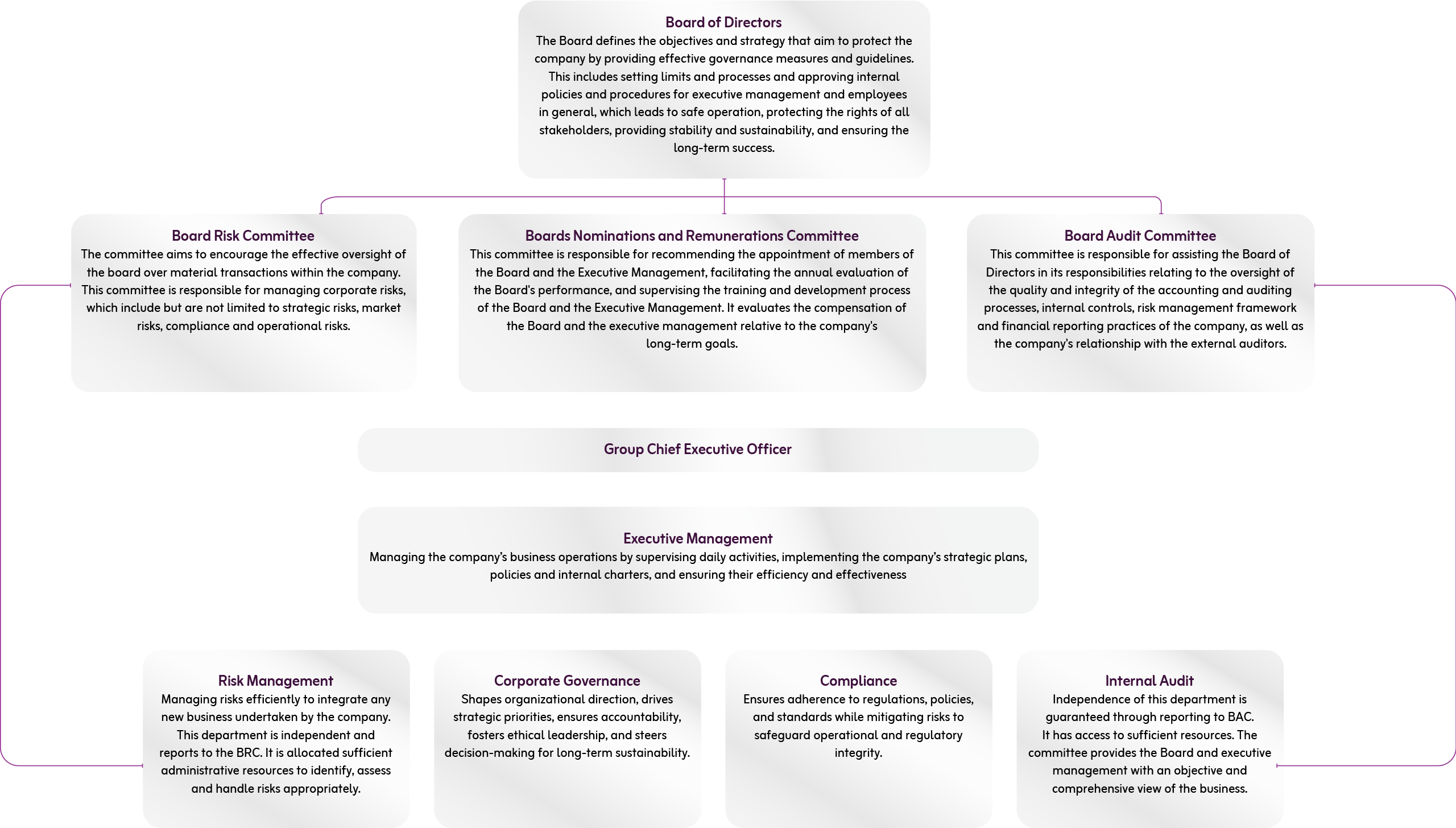
Relationship between the Board of Directors and Executive Management
Governance Framework Regulating the Relationship
The relationship between the Board of Directors and executive management is governed by a clear and integrated governance framework, supported by a detailed and well-defined delegation of authority matrix, in line with the requirements of the Capital Markets Authority (CMA). This framework aims to ensure clarity of authorities, integration of roles, and enhanced effectiveness of oversight and accountability. It is underpinned by a shared understanding of the Company’s vision, mission, and strategic objectives, ensuring that executive decisions remain fully aligned with the directions approved by the Board.
Allocation of Roles and Authorities
The Board of Directors is responsible for providing strategic leadership, approving general policies, setting long-term objectives, and overseeing the performance of executive management, thereby safeguarding the interests of shareholders and other stakeholders. In turn, executive management is responsible for operational management, implementing the approved strategies and policies, and achieving the Company’s objectives within the approved frameworks and in compliance with applicable laws and regulations.
Independence of Decision-Making and Balance of Powers
In compliance with the applicable laws and regulations in Kuwait, the roles of Chairman of the Board and Chief Executive Officer are separated to ensure an appropriate balance of powers and to reinforce the independence of oversight from executive functions. This separation supports transparency, mitigates conflicts of interest, and enhances the overall effectiveness of the governance framework.
Empowerment with Oversight
The Board adopts an approach that empowers executive management to perform its duties effectively by setting clear performance objectives and well-defined authority limits, while retaining an effective oversight role. This approach enables executive management to operate with responsible operational autonomy, while remaining fully accountable for performance and results.
Monitoring and Performance Evaluation
The Board exercises its oversight responsibilities through periodic monitoring and evaluation of executive management performance, based on approved performance indicators. This process ensures clarity of expectations, supports continuous improvement, enhances execution quality, and contributes to the achievement of the Company’s strategic objectives.
Sustainability and Environmental, Social and Governance (ESG)
The Board oversees the integration of environmental, social and governance (ESG) principles into the decision-making process and ensures that policies and operational practices are aligned with long-term sustainability objectives and the safety and well-being of the communities in which the Company operates. This approach supports the creation of sustainable value for shareholders and stakeholders.
Corporate Culture and Communication
The relationship between the Board of Directors and executive management is founded on a corporate culture that emphasizes effective communication, transparency, and mutual trust. Executive management is committed to implementing the Board’s decisions within the approved framework, ensuring alignment between strategy and execution and enhancing the Company’s overall performance.
This integrated framework reflects an effective governance model that supports the Company’s sustainability and strengthens its ability to adapt to regulatory and competitive developments, in line with the requirements of the CMA and leading international best practices.