
Risk Management
Safeguarding Zain to ensure business continuity
Zain Group operates in a highly regulated, extremely competitive, and rapidly evolving environment. This landscape is growing more complex due to the strategic focus to grow adjacent businesses and significant investment to maximize returns from the digital economy.
The unprecedented uncertainties in the external environment meant that the Group’s risk landscape evolved – as shown in the Enterprise Top Risks section – and, similarly, the Group’s approach to governance and risk management is adjusting accordingly.

Safeguarding the business through three lines of defense
Zain Group’s Enterprise Risk Management (ERM) function plays a critical role within the company, reporting independently to the Board Risk Committee (BRC), which meets at least quarterly to discuss the risk profile of the organization. The BRC oversees the implementation of a strategic risk assessment exercise across Zain’s operations, while also reviewing and approving the risk management framework on an annual basis.
In addition, the BRC oversees compliance with risk management policies and procedures, and reviews the adequacy of the risk management framework in relation to the risks faced by the organization, from operational risk management, cybersecurity, and operational resilience.
Ultimately, management remains responsible for ensuring the adequacy and effectiveness of the Group’s control environment, thereby limiting the likelihood and impact of risks that may materialize and exceed the approved appetite. The ERM function, through the existing governance structures, assists management by monitoring the implementation of effective risk management practices across the Group. Finally, Internal Audit provides independent and objective assurance to management and the Board on the adequacy of risk management and the effectiveness of the control environment and, through its mandate, facilitates the continuous improvement of the Group’s governance practices.
Three Lines of Defense Model
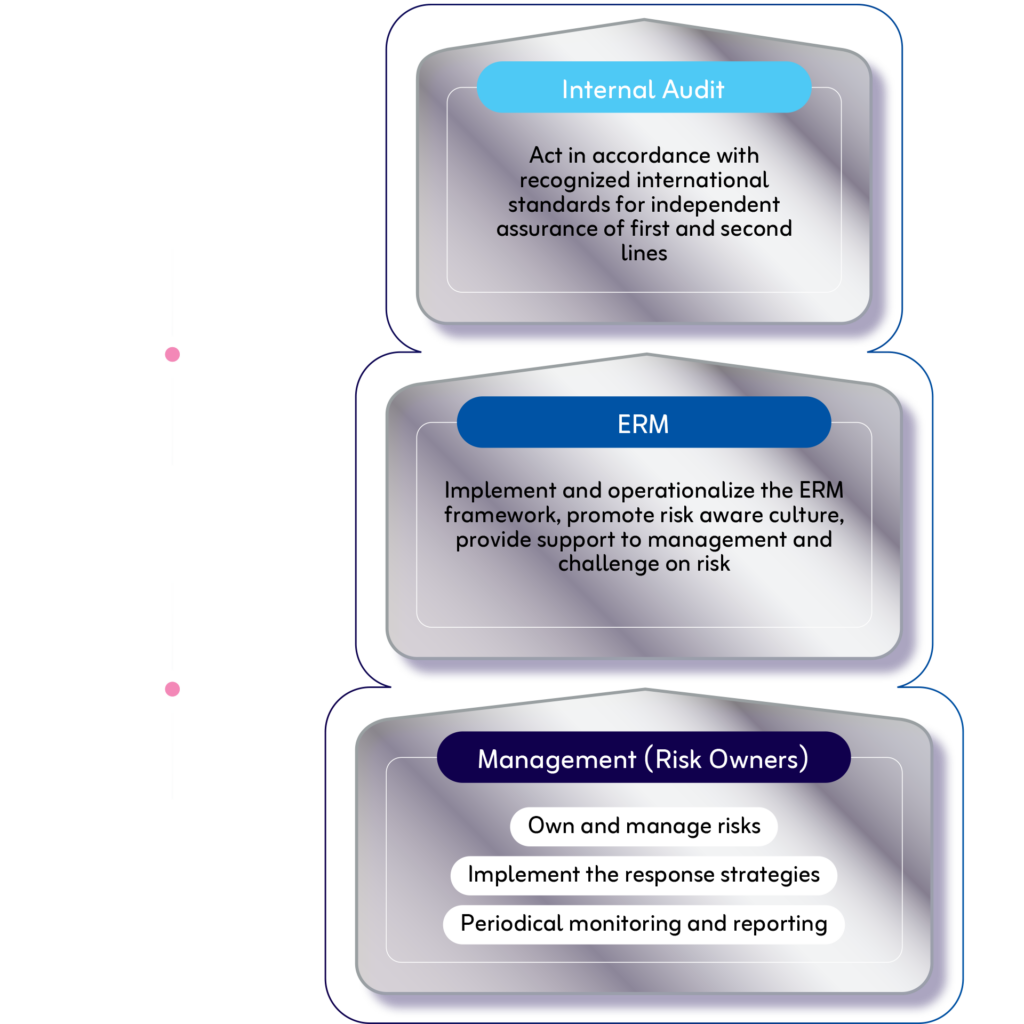
The Group’s ERM function performs a pivotal role in ensuring the resilience of Zain’s strategic plans and operations, including but not limited to the following activities:
1. Periodically scanning the environment to ensure that the company maintains an up-to-date view of the key risks that may affect it and provide those views to management on a regular basis at various engagement points, including through reporting to BRC.
2. Engaging with the community of risk professionals, risk champions and ERM teams across operating entities and international subsidiaries, providing them with the necessary tools and training, and supporting them to achieve their objectives and continuously raise the bar in terms of the quality of risk management practices across the Group.
Enterprise Top Risks
In accordance with Zain’s risk management process, the company scans, assesses, and monitors the Group’s risk and control environment on an ongoing basis, proactively seeking to reduce risk exposures down to acceptable levels.
In line with this process, the table below summarizes several of Zain’s risks and describes the high-level approach to managing them.
| Risks | Description | Impact | Mitigation |
|---|---|---|---|
| Evolving regulatory regime (Strategic) | As Zain operates in diverse markets, the company faces legal and regulatory challenges. The authorities can alter current regulations and implement new ones, which can significantly influence the organization’s operations and financial performance. | Increased cost of operations (license fees, cost of regulatory compliance) leading to reduced profits. Delay, or postponement in launch of new businesses and services to create new revenue streams due to lack of regulations or delay in regulators’ clearance. | Collaborate with market regulatory authorities and other stakeholders, engaging in market issues, with a clear focus on common benefits. Innovation on new products and services to enhance revenues and overcome increased regulatory costs. |
| Geopolitical & macro-economic situation (Strategic) | Zain operates in multiple markets, and changes to macro-economic indicators impact operations significantly. Geopolitical hindrances lead to reduced access to capital and technology. Political unrest causes disruption to operations and revenues. | Reduced customer spending leads to reduced revenues impacting the execution of the company’s strategy. Weakening local currencies in certain subsidiaries affects the profitability of Zain’s operations and asset valuation. Hikes in interest rates increase the cost of debt in certain subsidiaries. | Ensure cost optimization initiatives and access to long- and short-term capital options through varied sources of funding. Employ various hedging instruments to offset rate hike impact. Ongoing improvement of Zain’s business continuity capabilities across operations. |
| Cybersecurity (Operational) | As technologies advance rapidly, cybersecurity threats are also evolving and need ongoing monitoring. | Customer data breach, financial, reputational, or regulatory consequences. | Ongoing enhancement of the company’s cybersecurity capabilities by conducting: 1. Periodic cybersecurity assessments 2. Latest security tools 3. Training and awareness programs. |
| Successful and timely implementation of Digital BSS Transformation program (Operational) | Billing and charging systems are critical to Zain’s business. The systems are being transformed in certain operations to offer attractive packages along with value added services with full scalability for B2C and B2B customers. | Delayed and incorrect implementation of the systems may lead to customer churn and cost overruns. | Formation of a dedicated cross-functional transformation team for planning and delivery of transformation programs. Develop transformation KPIs for the program and associated stakeholders with close follow-up and dedication from Board and management |
| Talent management (Operational) | Digital transformation strategies require transformation of workforce capabilities and skills, as talent acquisition / talent upscaling needs are pronounced in domains such as machine learning, data science, AI, and software-based networks. | Business initiatives leveraging digital platforms and new skillsets will be affected, leading to disruption to digital transformation programs. | Re-structuring organizational structure to align with a digital future while maintaining an effective balance between external hires, contractors, and an internal re-skilling program. Initiatives to attract digital/tech talent by creating a compelling value proposition for prospective talent. |