
The following section addresses Zain’s response to the Task Force on Climate-Related Financial Disclosures (TCFD) in alignment with the guidance on the framework.
Zain’s Climate Action Journey
2012
First Sustainability Report
2016
Completed first five year target cycle
2017
Aligned CO2 emission actors for IEA Standards
Set new CO2 emissions reduction targets for five years
2018
Updated Zain’s Enviromental and Social Management Plan to incluce IFC recommendations
2019
Became a member of the GSMA Climate Action Task Force
Disclosed to CDP – private
2020
Disclosed to CDP – public
Established a Climate Action Committee (CAC)
2021
Achieved A- score (leadership) through CDp
Plan to introduce Internal Carbon Pricing (ICP)
Plan to commit to SBTI
Published ZAIN’s Climate Change Policy
2022
Developed the Climate Change Compilance Framework (approved by the Board)
Formal commitment letter approved by SBTI and received acceptance letter on January 6, 2023
Set new CO2 emissions targets for five years
2023
Board approved Waste Management Policy
Submission of Science-Based Targets to the Board of approval
The joint creation of Sustainability Innovation Hub under the GCC Telco Alliance
2024
Board approved Waste Management Compliance Framework
Zain’s Science-Based Targets have been approved by the Science-Based Targets initiative (SBTI)
2025
Launched Climate Transition Plan
Continued Scope 1 and 2 Reasonable Assurance and added Scope 3 this year
Governance
a. Describe the Board’s oversight of climate-related risks and opportunities
The Vice-Chairman and Group CEO of Zain is responsible for setting the strategic direction for the company. He also leads the implementation of the company’s strategy, which includes climate change-related adaptation and mitigation plans.
Zain performs an annual review of its five-year business plan to align future investments with its strategic direction set by the Board. The revised five-year business plans and annual budgets are consolidated and submitted to the Board for approval at the end of each year. These plans and budgets include capex requirements for the implementation of energy-saving initiatives that would help achieve the company emissions targets. Throughout this process the Vice Chairman and Group CEO oversees and guides the development of Zain’s climate transition plan.
As part of the governance process, Zain’s Board reviews and approves the business plans and budgets submitted annually by the Group CEO, which becomes the reference for the execution of the company’s strategy. The Board, through the Group CEO, monitors the implementation of all initiatives including those related to climate change mitigation and adaptation. The Group CEO has given the responsibility of managing day-to-day climate-related issues to the Group Chief Sustainability (CSO) and Group Chief Technology Officers (CTO) who co-chair the Climate Action Committee (CAC), and whose roles are to ensure the approved climate change mitigation and adaptation initiatives are properly implemented. The CSO and CTO report directly to the Vice Chairman and Group CEO who in return reviews Zain’s climate-related performance and provides guidance to the CAC for preventive and corrective actions when required to ensure that the company meets its targets.
The CAC is a cross-functional committee established following an internal consultation process, with the purpose of providing the Board with oversight into climate-related matters. Through the CSO and CTO, the CAC provides recommendations to the Board on how to manage climate-related risks and opportunities. The Board reviews and approves the recommendations from the CAC, and these approvals are reflected by the CAC in the company strategy for identifying, assessing, and managing climate-related risks and opportunities.
The CAC meets quarterly to discuss climate-related risks and opportunities that are immediately reported to the Board through the Group CEO, who provides recommendations and guidance. The reports to the Board by the CAC are done during regular quarterly Board meetings, whereby all management issues are also discussed. Board decisions on reported climate-related issues are made as frequently as needed, with the quarterly reviews focusing on ensuring that the company is meeting its climate specific key performance indicators (KPIs) in terms of greenhouse gas (GHG) emission levels, fuel and electricity consumption, waste management, and public awareness on climate change. By monitoring such KPIs on a quarterly basis, the Board can assess, evaluate, and support the company’s performance regarding climate change-related issues. In addition, the Board has a clearer viewpoint of the progress the company is making in this regard.
Zain provides its management team with incentives for its contribution to helping achieve its environmental commitments and transition goals as set in the Board’s approved climate change compliance framework. This framework outlines the strategic path to achieving net-zero emissions by 2050. The objectives and KPIs within the framework are disseminated to team members at both the Group and operation/subsidiary levels. All stakeholders, including operations/subsidiary CEOs, CAC members, and employees responsible for supporting climate targets, are assigned clear climate action objectives. The company conducts an annual assessment of its management team’s overall performance, including climate change mitigation and adaptation efforts. This assessment determines monetary rewards based on the progress towards achieving the predetermined objectives.
b. Describe management’s role in assessing and managing climate-related risks and opportunities
The Board, through the Group CEO sets the direction that shapes the strategy of the company for addressing climate change. All management issues including climate-related matters such as the company’s CO2 emission reduction targets status, risks associated with ambient temperature increase, the possible changes in precipitation pattern, as well as the transition to new technologies due to climate change. These issues are the responsibility of the Group CEO, who delegates the day-to-day operations and control of climate-related issues to the CAC co-chaired by the CSO and the CTO.
Below is a summary of the roles and responsibilities of each major management function within the CAC:
- Chief Financial Officer (CFO): Manages annual budgets related to environmental issues, reviews climate-related initiatives business cases and approves associated project budgets. Manages capital requirements and reviews decisions about investments in new technology such as the use of renewable energy and the deployment of energy efficient solutions.
- Chief Technology Officer (CTO): Oversees the selection, testing, and implementation of new technologies within the company. To ensure that transition risks and opportunities such as the deployment of energy efficient solutions are properly managed, the CTO’s contribution is key. He is responsible for energy efficiency improvements and energy use. He also measures and reports energy use against targets. The CTO sets emissions-related KPIs and monitors the implementation of low emissions solutions. The CTO co-chairs the CAC with the CSO. Both CTO and CSO provide an oversight to the Board into climate-related issues and ensure that recommendations from the Board are considered in the company’s strategy for addressing climate-related issues.
- Chief Sustainability Officer (CSO): This executive has a central position with respect to Zain’s climate agenda. The CSO strategically drives the company’s net-zero ambition by ensuring that all value chain emissions are properly addressed through a framework that runs from the emissions boundary to the scopes; the timeline; and the engagement with suppliers and local authorities. The CSO has day-to-day responsibility for the implementation and reporting of all climate-related issues within the company. She provides guidance and recommendations for climate change and sustainability strategy, monitors climate-related KPIs (emissions, renewable energy objectives, climate awareness and engagement), and climate-related incentives. The CSO co-chairs the CAC with the CTO. Both CSO and CTO provide an oversight to the Board regarding climate-related issues and ensure that recommendations from the Board are considered in the company’s strategy for addressing climate-related issues.
- Chief Risks Officer (CRO): The CRO integrates climate-related risks and opportunities into a Group-wide risks and opportunities identification and management process to ensure that climate-related risks and opportunities are properly managed.
- The CRO identifies and quantifies climate change risks and opportunities, performs scenario analysis, prepares mitigation plans for the identified climate change risks, monitors those risks, and ensures proper response whenever the risks materialize.
- The CRO ranks the risks on an annual basis to prioritize them and provides recommendations for mitigation and adaptation.
- On a quarterly basis, the CRO reports the status of all the identified risks, including climate change-related risks to the BRC.
- The BRC reviews the risks and sets priorities for mitigation and adaptation when required.
- Those priorities are part of the recommendations that the Board provides to the CAC through the Vice-Chairman and Group CEO.
Strategy
The information included below reflects figures and analysis for 2025.
a. Describe the climate-related risks and opportunities the organization has identified over the short-, medium-, and long-term.
Short-term
1 to 3 years
Comment: The short-term time horizon is aligned to the company’s business planning process. The short-term business plan considers this period for the operational risks arising due to climate change events that need to be addressed to enhance services to remain competitive throughout markets. The normal lifetime of some of our assets such as diesel generators used on off grid sites is approximately three years, hence, we consider three years to be a reasonable period for assessing the impact of physical risks on such assets. From a financial and strategic perspective, Zain’s short-term horizon is focused on development and achievement of revenue forecasts, cost targets and profitability targets.
Medium- term
3 to 5 years
Comment: The medium-term time horizon is aligned to medium-term business planning process that uses a five-year horizon period for the operational risks arising due to climate change events. This period is also in line with the lifetime of other assets such as the deep cycling batteries, which are used to mitigate the risks associated with some of the physical and transition risks. Zain’s five-year business plan is prepared every year while monitoring the progress of the previous year’s five-year plan’s execution. The business plan is updated with actual figures for the first year and the revised forecast for four years, subsequently an incremental year is added
Long-term
5 to 15 years
Comment: The long-term business financial planning process is planned for over 5 -15 years to align with Zain’s goals of climate change initiatives. A significant portion of the company’s assets, including cooling systems, DC power systems, radio systems, and other active equipment in transmission and core sections, are gathered during this specific timeframe. The impact of physical risks on such assets is evaluated and mitigated to ensure that the company remains competitive in its markets of operation. From a strategic perspective, a business plan entails the long-term horizon and is focused on a forecast of cashflows and revenue potential from the initiatives that Zain identifies as part of the organization’s strategy.
Risks identified as input to the Strategies for scenario planning
Transition risks: Increase in energy tariffs
During the assessment of climate-related risks for data centers, telecom core sites, offices, and base station facilities, Zain identified that there could be an increase in operational expenditure (opex) due to fuel tariff hikes and grid power units in areas of operations.
The biggest operating costs are energy-related to cateing for cooling requirements for telecom and IT systems that require temperatures of approximately 23°C for optimum performance, which is much lower than ambient temperatures in Zain’s markets of operation. The total energy consumption in 2025 was 1240.39 GWh and 128.4m liters of diesel across Zain’s operating entities.
For the Strategies for Scenario Planning 2 (SSP2) – 4.5 2039 scenario, it is estimated that energy operating costs could increase by approximately 61% to USD 314.57M. The estimated figures factor in the underlying per unit grid power and diesel fuel hikes as per macroeconomic indicators due to inflation and gradual reduction of subsidies.
The increase in costs is primarily due to:
- Rise in energy tariffs due to inflation
- Rise in mean temperatures
Zain estimates the increase in tariffs per liter of diesel and per kWh of grid power as per inflation rates in each of Zain’s operations are due to varying macroeconomic profiles.
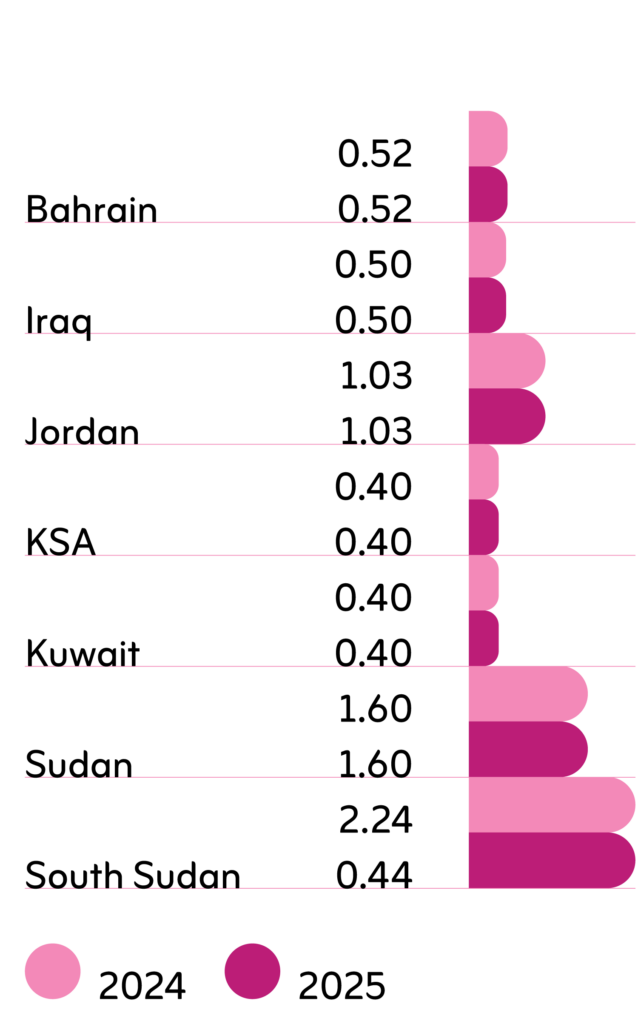
Diesel Fuel price (USD) per liter across OpCos
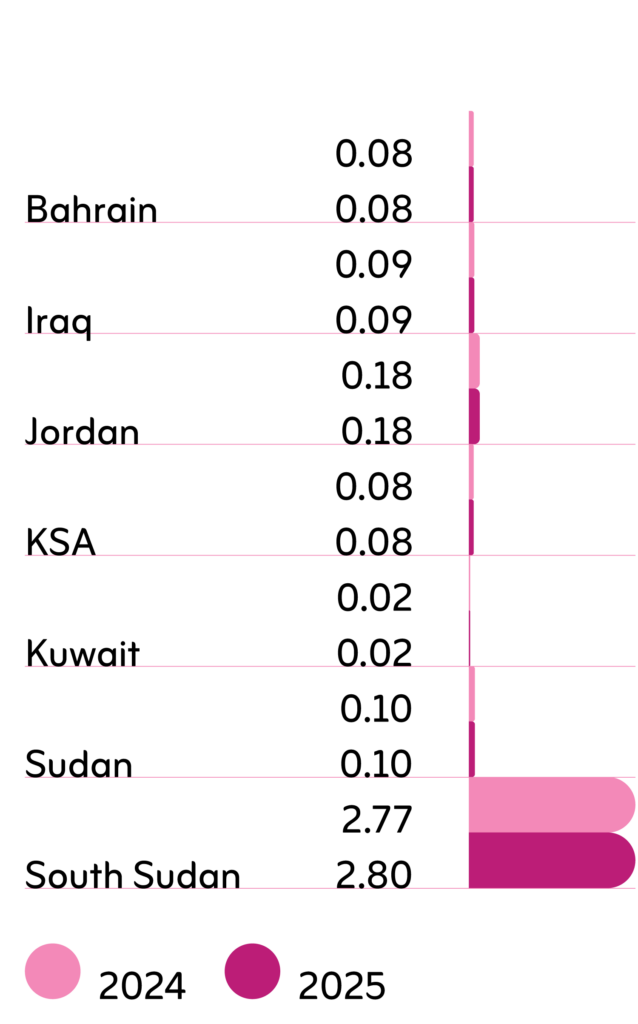
Grid price (USD) per unit kWh
Physical Risks: Rise in Mean Temperature
The Middle East and North Africa (MENA) region experiences extremely hot weather temperatures, which led to energy consumption increases in 2025. According to multiple studies, including the projections of the World Bank Group (WBG), the region will continue to face increasingly high temperatures for longer periods under current scenarios (SSP2 4.5 – means business as usual).
Opportunities Identified
Returns on investment in low emission technology
Zain noticed that it could achieve savings in energy consumption by reducing dependency on fossil fuels, which would lead to CO2 emissions and opex reductions. The driver for this initiative was the erratic availability and pricing of diesel in Zain’s markets, especially in Sudan and South Sudan.
The availability of a reliable universal grid supply is essential for economic growth and the alleviation of poverty.
While the South Sudanese government’s desire to modernize and extend on-grid coverage and introduce additional generation capacity is commendable, until such time when a stable political and conflict-free environment exists in the country, the current challenging state of the nation’s main utility supply is likely to persist for the foreseeable future.
To address ongoing power challenges, Zain implemented a range of green energy solutions, including battery-hybrid systems, solar installations, outdoor equipment modernization, grid connections for base station sites, and site-sharing arrangements with other mobile network operators. Zain’s strategic approach focuses on converting identified physical and transition risks into opportunities by adopting solutions that reduce operating costs while ensuring payback periods do not exceed six years. The deployment of energy-efficient technologies resulted in an opex reduction of USD 5.50m in 2025, with benefits expected to continue for at least an additional five years, corresponding to the operational life of the installed equipment. These initiatives also contributed to a reduction of 14,123 metric tons of CO2 emissions in 2025. While the opportunity extends across Zain’s wider operations, Iraq, Sudan, and South Sudan represent the primary beneficiaries due to their grid availability constraints and the elevated cost of diesel driven by local currency devaluation.
a. Describe the impact of climate-related risks and opportunities on the organization’s businesses, strategy, and financial planning.
The success of risk management will depend on the effectiveness of the management framework providing the foundations and arrangements that will embed it throughout the organization at all levels. The risk management framework operates at varying levels and within specific contexts of the organization. The framework ensures that information is adequately reported and used as a basis for decision-making and accountability at all relevant organizational levels.
The Group Enterprise Risk Management team develops an annual risk plan to include all Zain operations for the purpose of scheduling periodic risk assessment exercises. During the assessment for a particular operation, the leadership of commercial and corporate divisions, and technology, define their risk attitude, including climate-change risks, which may affect their businesses. Risk severity is reviewed to ensure alignment and acceptability.
As per risk management methodology, Zain’ risk assessment impact matrix has a five-point scale based on financial indicators, namely revenue, capex intensity, and operational EBITDA margins. The highest impact grading is “extreme,” which would be applicable for an event when its financial impact exceeds the most significant thresholds. For substantive financial impact, the company identified thresholds to determine if a risk has the potential to significantly affect the company and needs to be reported.
Zain’s risk management corporate policy defines an acceptable risk as the degree of exposure that the company is ready to accept in as much as it allows the creation of value, achieving the right balance between growth, performance, and risk. This threshold is considered when reviewing the strategy to ensure we operate within the established risk appetite.
The following are the thresholds for substantive or high financial impact as per Zain’s risk matrix:
- Whenever there is a risk that results in an impact on gross revenue of more than 4% of operation’s annual revenue.
- When capex intensity planned for the fiscal year exceeds 10% (where capex intensity is the ratio between capex to revenue).
- When the impact of the risk event exceeds EBITDA margins of the operations by more than 3%.
b. Describe the resilience of the organization’s strategy, taking into consideration different climate-related scenarios, including a 2°C or lower scenario.
The success of risk management will depend on the effectiveness of the management framework providing the foundations and arrangements that will embed it throughout the organization at all levels. The risk management framework operates at varying levels and within specific contexts of the organization. The framework ensures that information is adequately reported and used as a basis for decision-making and accountability at all relevant organizational levels.
The Group Enterprise Risk Management team develops an annual risk plan to include all Zain operations for the purpose of scheduling periodic risk assessment exercises. During the assessment for a particular operation, the leadership of commercial and corporate divisions, and technology, define their risk attitude, including climate-change risks, which may affect their businesses. Risk severity is reviewed to ensure alignment and acceptability.
As per risk management methodology, Zain’ risk assessment impact matrix has a five-point scale based on financial indicators, namely revenue, capital expenditure (capex) intensity, and operational EBITDA margins. The highest impact grading is “extreme,” which would be applicable for an event when its financial impact exceeds the most significant thresholds. For substantive financial impact, the company identified thresholds to determine if a risk has the potential to significantly affect the company and needs to be reported.
Zain’s risk management corporate policy defines an acceptable risk as the degree of exposure that the company is ready to accept in as much as it allows the creation of value, achieving the right balance between growth, performance, and risk. This threshold is considered when reviewing the strategy to ensure we operate within the established risk appetite.
The following are the thresholds for substantive or high financial impact as per Zain’s risk matrix:
- Whenever there is a risk that results in an impact on gross revenue of greater than 4% of operation’s annual revenue.
- When capex intensity planned for the fiscal year exceeds 10% (where capex intensity is the ratio between capex to revenue).
- When the impact of the risk event exceeds EBITDA margins of the operations by more than 3%.
c. Describe the resilience of the organization’s strategy, taking into consideration different climate-related scenarios, including a 2°C or lower scenario.
Climate-related Scenario
Transition Scenario IEA 450
Scenario Analysis Coverage
Company-wide
Parameters, assumptions, analytical choices:
Temperature alignment: The company explored changes in energy costs under one of the IEA scenarios, namely the IEA 450, which is aligned with temperature increases to or below 2°C compared to pre-industrial levels. Parameters, assumptions, and analytical methods increases in energy tariffs will lead to an increase in energy costs for the operation of telecom/IT sites.
During the assessment of climate-related risks for data center locations, offices, and base station sites, Zain identified that there could be an increase in operational expenditure due to tariff hikes for fuels and grid power units in areas of operation. Energy prices are subsidized in oil rich operations in Kuwait, Saudi Arabia, and Bahrain. The biggest operating costs are energy-related to cater for cooling for telecom and IT systems, which require temperatures of 22°C, which is much lower than the average ambient temperatures in these markets.
Zain’s total energy consumption in 2025 was 128.4 Liters and 1240.39 GWh across seven operations. The 2025 overall energy cost was USD 195.3m from the 2024 overall energy cost which was based at USD 155.26m.
Overall energy costs including diesel in 2025 was USD 195.34. With Zain’s long-term planning process of 14 years, it estimates that energy operating costs could increase by over 60% to USD 314.57 m in 2039.
The estimated figures factor in the underlying per unit grid power and diesel fuel hikes as per macroeconomic indicators due to inflation and gradual reduction of subsidies.
The increase in costs is primarily due to two main variables: 1. A rise in energy tariffs due to inflation and reversal of subsidies in some operations, and 2. A rise in mean temperature.
Climate-related Scenario
Physical Climate Scenarios SSP 5 8.5
Scenario Analysis Coverage
Company-wide
Parameters, assumptions, analytical choices:
This business-as-usual scenario (SSP 2 4.5) assumes temperature increases by 0.92°C by 2039 and 1.6°C by 2059 compared to pre-industrial level.
Parameters, assumptions, and analytical methods: Zain relies on World Bank Group (WBG) forecasts, that use data from the CMIP6 models included in the IPCC – AR5 as a reference to help project climate change states for the entire company. Two-time horizons were considered: 2020 – 2039 and 2040 – 2059. These two horizons are the default horizons proposed by the WBG using the CMI6 models for climate change projections.
Within these horizons, and considering a linear progression, a 15-year climate change analysis from 2020 to 2035 (main time horizon) was derived to align with Zain’s corporate risk management long-term timescale and the life cycle of its assets. The company explores both physical and transition risks for Zain’s base stations, data centers, and office buildings.
As per SSP 8.5 Ensemble, there will be an average temperature increase of 0.99°C by 2039 and 2.19°C by 2059.
A vulnerability assessment of Zain’s operations revealed that some of the company’s assets in the seven operations will consume more power to maintain the same level of temperature because of the positive correlation between external temperatures and energy consumption.
To reduce the energy consumption due to increased cooling requirements, a set of initiatives has been developed under one of the strategic pillars which is, “operational effectiveness.” These initiatives helped reduce 806 metric tons of CO2 emission in 2025.
Climate-related Scenario
Physical Climate Scenarios SSP 1 2.6
Scenario Analysis Coverage
Company-wide
Parameters, assumptions, analytical choices:
Temperature alignment: The company’s ambition is to be net-zero by 2050. To understand the impact of such a move on the business, Zain looked to uncover associated costs. This analysis is based on SSP 1 2.6 pathway that limits the rise in mean temperature to 1.5°C compared to the pre-industrial era. Parameters, assumptions, and analytical methods: The parameters considered in this analysis are the number of sites, energy consumption per site, and the share of renewable power.
The projected energy consumption is based on the number of sites in 2050, against a set of initiatives ranging from the deployment of hybrid battery solutions, outdoor cabinets, and solar power solutions. Although energy consumption is likely to increase, the fact that the share of solar-based power increases at a faster rate helps predict substantial reductions in CO2 emissions. It is assumed that solar plants will be deployed in operations in Bahrain, Sudan, South Sudan, Kuwait, and Jordan for the company to be able to achieve 80 – 90% reduction of CO2 emissions by 2050. The remaining 10 – 20% of the emissions will be offset through investments in carbon sinks and the implementation of carbon capture solutions.
Risk Management
a. Describe the organization’s processes for identifying and assessing climate-related risks?
The company recognizes that climate change poses several physical and transition-related risks to its business.
The risk assessment process consists of four steps: Risk identification, analysis, evaluation, and treatment. The scope of the risk assessment processes includes all people, processes, and technology within Zain Group and its operating countries.
Risk Identification: Risk owners and the risk management team review the risks specific to the division and identify any emerging issues that are material to the operating environment.
Risk Analysis: For the identified risks, impact of the risk event is based on the likelihood of occurrence and the impact severity of the identified risk events.
Risk Evaluation: For the identified risks, the management team assigns risk owners who perform detailed root cause analysis of their respective risk and take actionable steps.
Risk Treatment: Mitigation plans are agreed between the risk manager and the risk owners.Operating company (opco) risk managers present the status of current and proposed plans for the approval of operation CEO. Once the mitigation plans are approved by the respective CEOs, risk managers share the risk register with the Group risk management team.
Climate change risks are considered in Zain’s risk universe as defined in Zain’s Risk Management Policy and included in the company’s risk assessment and evaluation. The Climate Change Risk process monitors both physical risks and transition risks.
Risks & opportunities Identification & assessment
The climate risks and opportunities identification process follows a bottom-up approach by advising operations based on analysis of historical and projected data related to physical and transition risks and opportunities.
Risk assessment exercises are conducted annually, where the Group Risk Management team identifies risks across short-, medium-, and long-term timeframes. Risks arising from climate change impact on operations, and macroeconomic factors are some of the long-term risks in the company’s register.
Risks are quantified based on the likelihood and impact as per the risk management criteria for revenue, EBITDA, and other metrics.
b. Describe the organization’s processes for managing climate-related risks.
For managing climate-related risks, energy sources are closely monitored. Fuel and electricity consumption patterns are analyzed to assess variations. In case energy consumption increases more than 10% quarter-on-quarter, the concerned operations are required to provide details and justifications for such changes.
The Coupled Model Intercomparison Project, Phase 6 (CMIP6) models included in the IPCC’s Sixth Assessment Report (AR6) were referenced. Global warming of 1.5C relative to 1850–1900 would be exceeded in the 21st Century under the intermediate, high, and very high GHG emissions scenarios considered in this report (SSP2-4.5, SSP3-7.0 and SSP5-8.5, respectively). For the analysis, Zain selected the following SSP scenarios: SSP1 – 2.6: Sustainability Road, SSP2 – 4.5: Middle of the Road, SSP5 – 8.5: Fossil fuel development.
The following estimations were taken per operation:
SSP1 2.6 2039: Kuwait (1.012), KSA (1), Bahrain (0.971), Iraq (1.113), Jordan (1.086), Sudan (0.863) and South Sudan (0.702).
SSP5 8.5 2039 and 2059: Kuwait (1.2222.492), Saudi Arabia (1.18, 2.453), Bahrain (1.158, 2.244), Iraq (1.302, 2.538), Jordan (1.258, 2.362), Sudan (0.923, 2.047), South Sudan (0.688, 1.643).
SSP2 4.5 2039 and 2050: Kuwait (1.018, 1.813), Saudi Arabia (1.035, 1.8), Bahrain (0.979, 1.688), Iraq (1.11, 1.854), Jordan (1.082, 1.731), Sudan (0.858, 1.496), South Sudan (0.628, 1.268).
The timeframes include Zain’s net-zero timeline, but the analysis went beyond 2050 to provide an understanding of the extent to which the business could be impacted in the long run.
Knowing the total cooling energy requirement for the previous year, Zain can estimate the total energy consumption increases that would result from the impact of that physical risk. When mapped to Zain’s risk criteria, this is Moderate as it represents approximately 1.96% of annual EBITDA.
The risk is said to manifest across all seven countries of operation, as the underlying energy consumption data is an aggregate from operations.
To mitigate the increase in energy consumption associated with heightened cooling requirements, Zain implemented a series of initiatives under its strategic pillar of operational effectiveness. In 2025, Zain deployed a total of 140 outdoor cabinets across its operating markets, all of which were installed in Bahrain at a cost of USD 1,531,188. While these outdoor cabinets do not eliminate the need for active cooling, it significantly reduces reliance on energy-intensive systems. The deployment of 140 outdoor cabinets featuring substantially higher energy efficiency compared to traditional telecom shelters incurred a total opex savings of USD 1.21m. Collectively, these initiatives resulted in a reduction of 806 metric tons of CO2 emissions, with additional emission reductions expected to continue for at least the next five years, aligned with the operational lifetime of the installed equipment.
c. Describe how processes for identifying, assessing, and managing climate-related risks are integrated into the organization’s overall risk management.
Zain is presenting a case study of a climate change risk, its impact, and the mitigation strategies.
Risk 1: Transition Risk: Increases in energy tariff will lead to an increase of energy costs for the operation of Zain’s telecom/IT sites.
During the assessment of climate-related risks for Zain’s core site, offices, and base station facilities, it was identified that there could be an increase in opex due to fuel tariff hikes and grid power units in Zain’s areas of operations.
The biggest operating costs are energy-related to cater for cooling requirements for Zain’s telecom and IT systems that require temperatures of approximately 23°C for optimum performance, which is much lower than ambient temperatures in Zain’s markets of operation. Total energy consumption in 2025 was 128.4 M liters and 1240.39 GWh of diesel and grid across Zain’s operating entities.
For the SSP2 – 4.5 2039 scenario, it is estimated that energy operating costs could increase by over 61% to USD 314.57 m. The estimated figures factor in the underlying per unit grid power and diesel fuel hikes as per macroeconomic indicators due to inflation and gradual reduction of subsidies.
The increase in costs is primarily due to:
- Rise in energy tariffs due to inflation
- Rise in mean temperatures
Zain estimates the increase in tariffs per liter of diesel and per kWh of grid power as per inflation rates in each of the company’s opcos due to varying macroeconomic profiles.
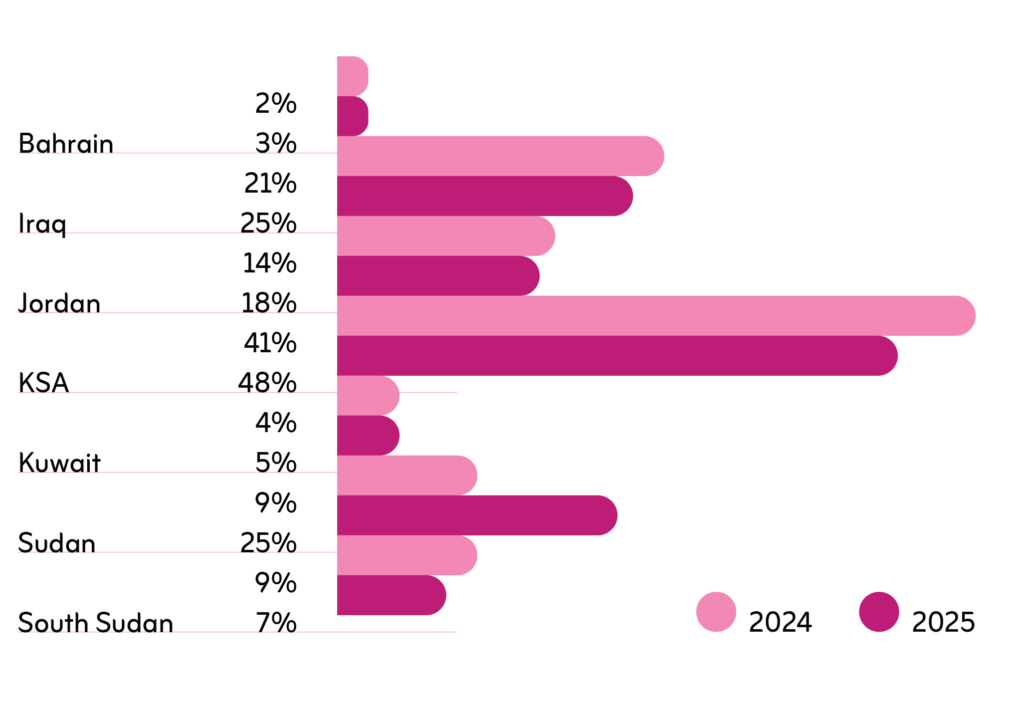
Energy cost contribution per OpCo
Mitigation
Zain’s network deployment guidelines require that passive infrastructure-sharing with other operators be prioritized as the first option before considering alternative approaches. Site sharing generally leads to reductions in energy consumption through the optimal utilization of power systems. This approach is particularly advantageous in countries such as Sudan and South Sudan, where most Zain’s base stations rely on diesel generators due to limited grid stability. In these markets, reducing fuel consumption provides the dual benefit of lowering energy costs and decreasing emissions.
Based on historical electricity tariffs, fuel price trends, and an analysis of operational data across Zain’s operating companies, it is estimated that if current patterns persist, the operating costs of Zain’s base stations could double by 2035. For example, in Sudan and South Sudan, where most sites are powered by diesel generators, any increase in fuel prices directly translates into higher energy costs. To mitigate this risk, Zain deployed 158 solar power solutions and 651 battery-hybrid power systems in 2025. These deployments are expected to result in an estimated 40 – 80% reduction in fuel consumption for solar solutions implementation and 25 – 45% reduction in fuel consumption for battery hybrid solutions over the five-year period beginning in 2025. To mitigate the risks associated with additional energy costs, Zain has developed a set of initiatives ranging from infrastructure sharing to the deployment of green power solutions, and the use of smaller size diesel generators.
Metrics and Targets
The information included below reflects figures and analysis for the years 2024 and 2025.
Disclose the metrics used by the organization to assess climate-related risks and opportunities in line with its strategy and risk management process.
Metrics used by Zain include emissions, energy consumption, and capital deployment.
Metrics |
Performance |
|
|---|---|---|
2024 |
2025 |
|
| Energy | ||
| Diesel Fuel Consumption (Liters) | Diesel fuel consumption decreased by 11% year-on-year (Y-o-Y) across all operations compared to 2023. | Diesel fuel consumption increased by 7.6% Y-o-Y across all operations compared to 2024. |
| Grid Consumption (KWh) | The total electricity consumption increased by 2% across all operations compared to 2023. | The total electricity consumption increased by 4.4% across all operations compared to 2024. |
| Average Fuel price per Liter |
Bahrain – 0.52 Iraq – 0.5 Jordan – 1.19 KSA – 0.31 Kuwait – 0.4 Sudan – 1.6 South Sudan – 2.24 |
Bahrain – 0.52 Iraq – 0.5 Jordan – 1.03 KSA – 0.31 Kuwait – 0.4 Sudan – 1.6 South Sudan – 2.8 |
| Average Grid unit price |
Bahrain – 0.077 Iraq – 0.09 Jordan – 0.18 KSA – 0.08 Kuwait – 0.016 Sudan – 0.1 South Sudan – 2.77 |
Bahrain – 0.077 Iraq – 0.09 Jordan – 0.18 KSA – 0.08 Kuwait – 0.016 Sudan – 0.1 South Sudan – 0.44 |
| Capital Deployment | ||
| Investment in climate mitigation |
Site Sharing Expenditure:
Energy Efficiency Expenditure:
|
|
a. Disclose Scope 1, Scope 2 and, if appropriate, Scope 3 GHG emissions and the related risks.
The following tables summarize the GHG emissions and related risks for 2023 across Zain Group.
GHG emissions
Scope of emission |
Unit |
Total |
|---|---|---|
| Scope 1 emissions | tCO2e | 358,605.16 |
| Scope 2 emissions | tCO2e | 683,974.68 |
| Total Scope 1 & 2 emissions | tCO2e | 1,042,579,838 |
| Total Scope 3 emissions | tCO2e | 480,403.68 |
Emissions risks
Scope |
Related Risks |
Summary |
|---|---|---|
| Scope 1 emissions | Increase in consumption of diesel. | The intermittent availability of grid power across certain operations—whether resulting from natural disruptions or man-made events may necessitate increased reliance on diesel generators as a backup energy source. Additionally, the rollout of 5G networks and the continued expansion of 4G coverage are expected to drive higher energy requirements, particularly for greenfield sites, which may further contribute to increased fuel consumption. |
| Scope 2 emissions | Increase in consumption of grid power. | The rollout of 5G networks and the continued expansion of 4G coverage are expected to drive higher energy requirements, particularly for greenfield sites, which may further contribute to increased fuel consumption. |
| Total Scope 3 emissions | Increase of both fuel and non-decarbonized grid utilization. | Increases in the use of fossil fuel-based energy or non-decarbonized sources of energy by our value chain suppliers and partners could increase both upstream and downstream emissions. |
b. Describe the targets used by the organization to manage climate-related risks and opportunities and performance against targets.
Initiatives |
Target |
Narrative |
|---|---|---|
| Enhance share of renewable power source | 2.5% increase per year. | The current energy source mix between fossil fuel and renewable sources is 91.2% and 8.8% respectively. Zain intends to increase this mix by 2.5% annually to reduce Scope 1 and 2 emissions. |
| Scope 2 emissions | 4.2% CO2 emission reduction per year. | The rollout of 5G networks and the continued expansion of 4G coverage are expected to drive higher energy requirements, particularly for greenfield sites, which may further contribute to increased fuel consumption. |
| Virtualization of core network | 75% in core. | Core network equipment such as CS Core, PS Core (2G,3G, 4G) and IMS for VoLTE require power on 24*7. The migration from legacy bare metal system design to virtualized core entails benefits of approximately 40% reduction in energy consumption as smaller equipment footprint translates to lower cooling and power consumption. |
| Digitalization | 2.5% per year. | The current mix for prepaid recharges and postpaid payments between online and traditional channels is approximately 35:65. Zain intends to enhance the online segment as this will entail a reduction of branch operation costs due to savings in energy costs at the branches for lighting and air-conditioning. |